I’ve had the same post in draft since 21st May 2025 and haven’t sent it. I started this blog in 1451 as a way to document the fall of Constantinople to write-think about my studies at the time, and I mostly will keep using it for that purpose. I was reading and thinking ‘I really need to write this down so I get it straight’ and remembered this is what a blog is for. Skip to the bottom if you find my reserach tiresome. I would.
Five Three Things
1. Landing
The landing strip is in sight for the thesis. I’ve managed to change to a fully written PhD which is an enormous relief because:
- 1. The practice/theory framework was mangled tf and I was struggling to pull it altogether. I’ve always treated everything – my own work, the work of other critical practitioners, real-life innovations and theory – as texts; that is I read and interpret them in comparison to each other. So being able to just flatten the methodology is enormously helpful.
- 2. At the end of August I sent the second of three substantial chapters to my supervisors and was not happy because I knew I’d had to cut things that were actually good, useful and insightful, not fluff to keep in word count. I get an extra 40,000+ words now (many of which I’m already in overdraft o anyway) which massively liberates my ability to write how I want.
So we’re on the third chapter now, starting to get into it after much delay for a surgery, a rush of organisational activity at Arup and 8 days break on Use, Usefulness and Users. The aim is to have a full draft in May and this chapter done by end of Feb which is… ambitious. Squeaky bum time.
So what? Don’t call, don’t write, don’t give me any interesting events to speak at or people to meet. For the love of my crow-brain, leave me alone a few months.
2. Users aren’t simple
I’m now writing the last (first in order) chapter of the PhD which is about how users are invented and configured in the design of AI. If you’ve seen me talk, I often triangulate my position relative to the lit review, and this goes something like:
- 1. Trevor Pinch and Weibe Bijker’s Social Construction of Facts and Artefacts which is the core theoretical position of the whole thesis – that technologies are interpretatively flexible and unsettled and only settle one all the different social groups involved have done jostling for domination of the definition of a technology.
- 2. Madeleine Akrich’s idea of technological ‘scripts’ – that designers and innovators try and inscribe scenarios or use cases for technology in their very design to try and dictate what it is for and how it should be used
- 3. And Steve Woolgar’s ‘configuring of users‘ – that there are various different definitions of ‘users’ within tech companies, internal politics play out as marketers, sales, technology people and board members all jostle to claim authority on deciding who the user is and what they want and then through instructions, terms and conditions and testing, what the user can do is configured for them.
However, this all got blown up a little by reading How Users and Non Users Matter where Nelly Oudshoorn and Trevor Pinch point out that all these approaches ascribe too much power to designers and not enough to users in shaping the definition of technology, especially in the context of consumer culture where technologies are as much symbolic as functional. So I’m currently catching up with some of the literature such as:
- Roger Silverstone and Leslie Haddon on how the ‘domestic’ (e.g. what happens once technology is in someone’s life and home) shapes users and shapes design in an upstream way. For example, as technologies are symbolic as much as functional, designers are influenced by the social expectations of users for futurity or power or beauty etc.
- Mackay et al. looking at a more ‘symmetrical’ approach to how meaning of technology is encoded and decoded and the influence of broader politics on how designers are configured by users.
A couple of these pointed at Agre’s Critical Technical Practice. If you don’t know this grimoire, it’s a sort of sacrilegious text from a reforming computer scientist; as much a personal mea culpa as the foundation for everything that has come after. I haven’t read it in four or five years and it needed re-reading in light of progress in the PhD and better understanding of the corpus of critical thinking on AI it led to. It felt very strange reading it; deferential and solemn. Especially given Agre’s personal story (or, mystery thereof.)
So what? It’s good to find a crack in social constructivism that I can explore in this chapter to talk about where it falls short and I can then more positively contribute. Though I regret the extra intellectual burden. I suppose a question for me to think about in writing this up is where/how can design research plug the gaps? See event hat thought is a product of writing this in a blog. Useful. Would recommend.
3. And mini(mega)fistoes
AI hype has triggered the re-emergence of LiveJournals from billionaires about how their particular AI-infused vision of the future is the best one. There’s Altman’s Intelligence Age which maybe started the fashion or Amodei’s Machines of Loving Grace, Suleyman’s Towards Humaniest Superintelligence coming in quite late, Zuck’s Personal Superintelligence and a bunch of other (see also the rebrand of AGI). Then there’s the influencers coming in to talk about their predictions for how AI is going to take over the world in 75,000-word pseudo-intellectual diatribes. These things are so common there’s a Github library and a great discourse analysis by Ben Johnson here.
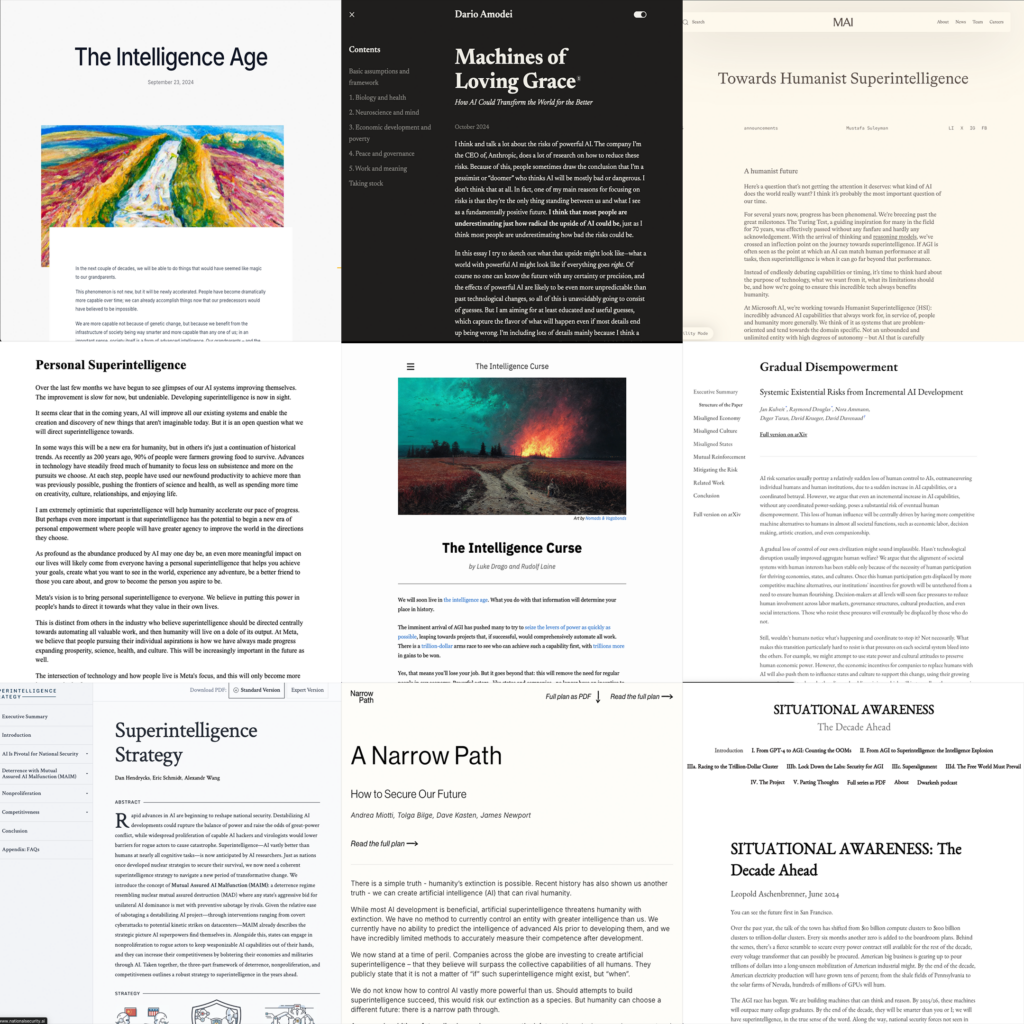
They’re all brutalist blocks of text. Some of them immensely long, almost invariably in a classic serif. Situational Awareness takes the biscuit, being done in Benne, a typeface designed for Dravidian Kannada script but deployed instead as a harbinger of the coming AI utopia. Now, in some of these cases you could go ‘ok, sure it’s a vibe.’ In Altman’s case I just don’t think he did anything to a wordpress template while Amodei was just slightly more intentional than that.
Zuck’s is interesting because, to look at it, you might think; ‘Well, this is just web brutalism, that well-known aesthetic that rejects overt styling, scripts and heavy CSS, sometimes as an ostensible argument to environmental-friendliness.’ After all. If you basically just copied the text into html and added a header tag and some padding with no other styling, this is basically what you’d get.
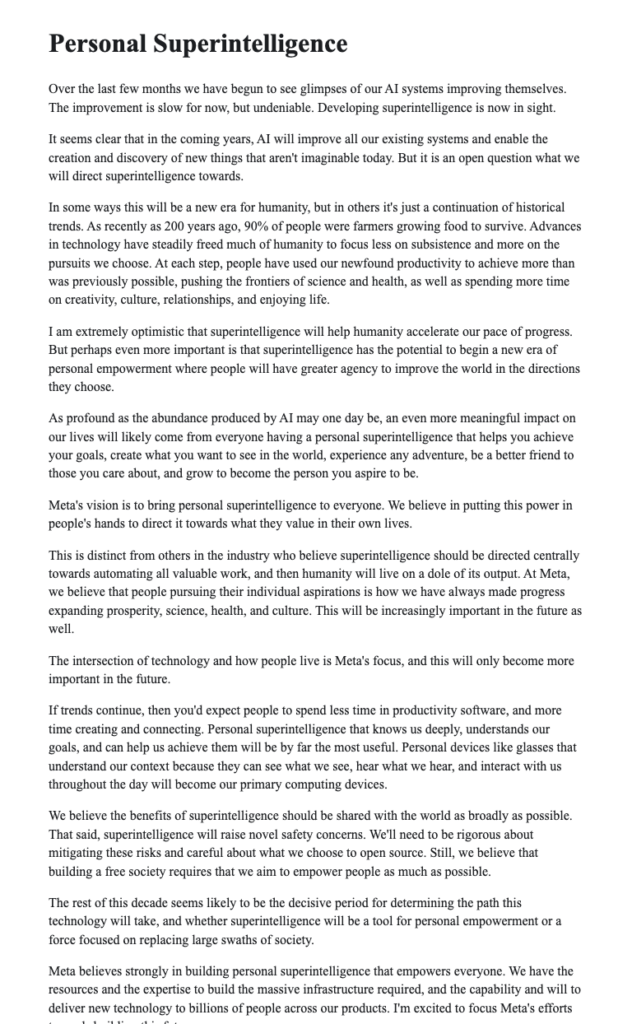
Well you’d be wrong. Zuck’s mercifully short screed, hosted on Meta’s website, has 19 different trackers on it as as well as a host of other scripts making it just as janky and feature-laden as the Facebook home page. This means that, far from being an off-the-cuff throwaway moment of thought leadership genius, it’s just another way of tracking you.
So what? I guess in the scheme of things, this whole thing doesn’t matter. There’s something extremely interesting though about the world’s wealthiest men, who told everyone we were all moving to video now, intentionally down-styling his corporate website to nail the zeitgeist. Johnson’s analysis is useful for getting into these more, the way they use affirmative language, vertical scrolling and weight expertise to convince you of their veracity, usually ending with a call to action to fund something, sign up to something or follow someone.
Recents
These were saved in the unsent draft from June, so not new, but still, not shared here and I have a literal box to tick. Including:
- This conversation on the PhD with Niklas Egberts at TU Dresden.
- Positioning AI with Maria Luce
- Interview with the Re-Pete project
I mean, I suppose the main thing, and a reason for not posting for six months is that on a whim (about two years ago admittedly), my friend and colleague Radha Mistry and I decided to start a podcast thinking it would be an amusing side quest which has turned out to be bigger than expected and so adding about five hours a week work to my already busy schedule. Futur-ish is here on Spotify, YouTube and Apple if you so chose.

Short stuff
(Sorry some of these are six months old but you may not have seen, so)
- Three-quarters of UK children spend more time inside than prisoners
- Here’s what Americans are googling
- India, Mexico and Malaysia are all vying to be the world’s next semiconductor hub.
- UAE is stepping up to US and China by releasing its AI for free.
- Mexico is building Latam-GPT cos they’re fed up with ChatGPT.
- In the US, vaccination rates for Measles and Polio has dropped below herd immunity rate of 95% to 92.5%.
- Italy’s big bridge.
- Interesting chat on Weibo about the amount of university lectures still teaching in retirement cos of money, including some over 100.
- And another one about how much entertainment and gizmology is embedded in everyday devices.
- The US government is embarking on an enormous crypto deregulation ‘blitz’. The New York Times reckon Trump has made $2.4bn on crypto btw.
- The UK’s National Drought Group who advise the government on drought mitigation recommends people deleting emails to reduce data centre usage.
- Ghana’s massive cocoa smuggling problem is behind the rising price of chocolate (well cliamte change is behind that)
- China and the USA are both heavily vying for influence in the Pacific Islands. Both are banned from this year’s Pacific Islands Forum but Naaru has taken $1bn from China in aid for renewables and agriculture.
- The price of Lithium continues to crash which is messing wtih China’s industry.
- NASA wants to put a nuclear reactor on the moon by 2030 as part of ambitions to build a colony.
- Hadn’t heard of Model Autophagy Disease before but I guess it makes sense.
- Julian here on that melancholic feeling you get when a design fiction becomes real. No sense of elation at having ‘predicted’ the future, just sadness that the thinking you were satirising turns out to be substantially real.
- A Sociology of Quantification, not new but I like the framework of locutionary, perlocutionary and illocutionary numbers. And for just generally on how numbers make meaning like ‘accounting realism’ in which “The reality of the objects measured in accounting realism is based on the trustworthiness of numbers established through standardized practices that are consistent, reproducible and ‘‘fair’’” (Espeland & Stevens, 2008, p.415) In other words, not literally true but generally agreeable.
- SUVs are 82% more likely to kill a child they hit.
So maybe we’re back. This wasn’t a New Year’s Resolution. My New Year’s Resolution was to drink more water. I’m still grateful to Past Tobias for setting up this template which has made getting this in here a matter of ten minutes rather than an hour.
Love you, speak later.